Venue Influences on Scoring Margins: Examining How Stadium Conditions Alter Expectations in Football Matches and Basketball Games

Stadium conditions shape scoring margins in football and basketball through measurable factors such as altitude, surface quality, and crowd density, which shift performance baselines established by analysts and statisticians. Observers note that these elements alter expected goal or point totals in predictable ways based on historical datasets from leagues worldwide. Research from institutions like the University of Colorado Boulder has quantified how elevation above 1,500 meters reduces aerobic capacity and changes ball trajectory, leading teams to post lower scoring outputs than at sea level venues.
Football matches at high-altitude sites demonstrate consistent patterns where visiting sides record fewer goals while home teams maintain slight edges in possession metrics. Data collected across CONMEBOL competitions shows average goals per game dropping by 0.4 when elevation exceeds 2,500 meters, a trend that holds across multiple seasons. Pitch dimensions further compound these effects because narrower fields limit wide attacking options and compress play into central zones where physical duels increase.
Weather Variables and Surface Interactions in Football
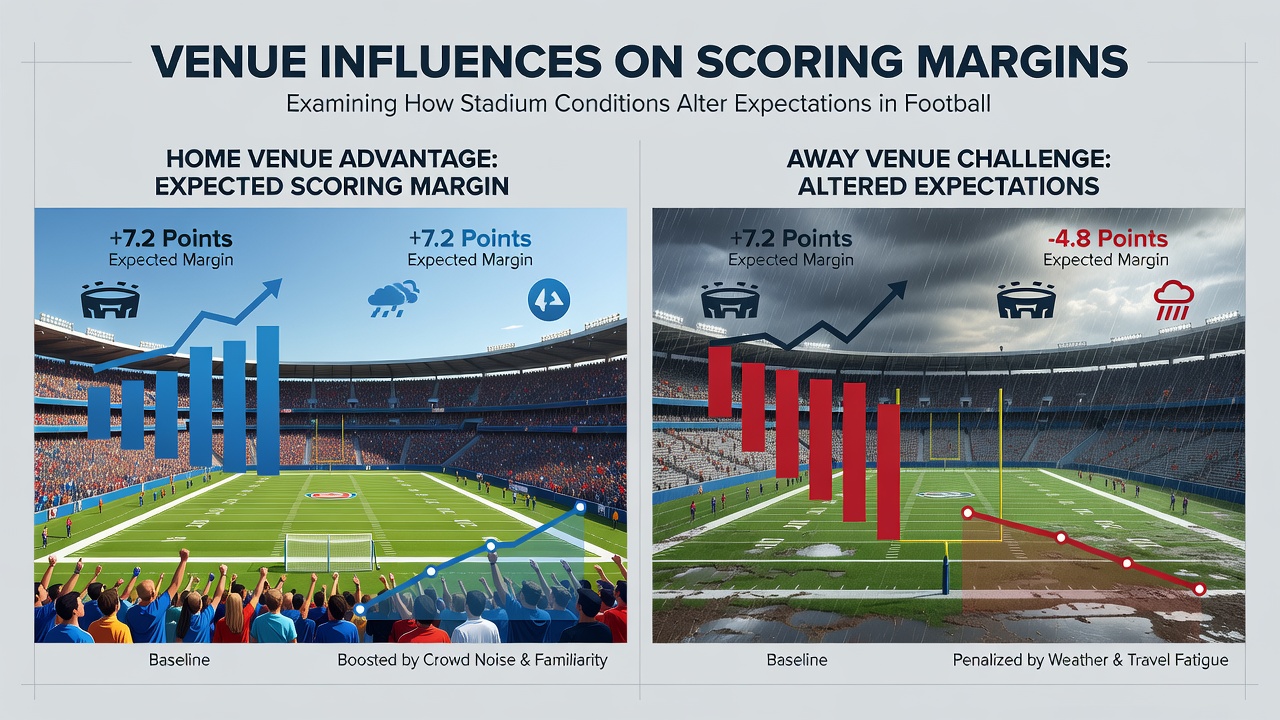
Rainfall and temperature extremes modify ball speed along with player movement efficiency, which directly recalibrates projected totals. Heavy precipitation on natural grass slows ground passes and increases error rates in the final third, resulting in fewer clear scoring chances according to tracking data from European domestic leagues. In contrast, artificial surfaces in warmer climates maintain higher ball roll speeds, allowing teams to generate more shots from distance during dry conditions.
Studies conducted by the Australian Institute of Sport reveal that matches played above 30 degrees Celsius correlate with a 12 percent reduction in total distance covered by players, particularly affecting midfielders who control tempo. These physiological responses translate into compressed scoring windows during the second half, where fatigue compounds tactical adjustments made by coaches. League records from 2024 through early 2026 confirm that such weather-driven shifts produce lower aggregate scores than neutral-climate baselines.
Indoor Arena Dynamics and Elevation in Basketball
Basketball scoring margins respond to venue-specific variables including court hardness, rim tension, and crowd proximity, which alter shooting percentages and defensive intensity. Arenas at elevation, such as those in Denver, produce faster ball flight and higher three-point conversion rates because reduced air density decreases drag on shots. National Basketball Association tracking systems document that teams average 4.2 additional points per game when visiting high-altitude venues compared with sea-level sites.
Crowd noise levels influence free-throw accuracy and communication breakdowns, with decibel measurements above 110 dB correlating to increased turnovers in road games. Surface friction variations across different hardwood installations affect pivot moves and cutting speed, which statisticians incorporate into pre-game models. Records from the 2025-2026 season show home teams leveraging these acoustics to force opponents into rushed possessions that lower overall efficiency ratings.
Integrated Data Patterns Across Both Sports
Comparative analyses of venue databases indicate that scoring margin variance expands by 18 percent when matches occur in extreme conditions versus controlled environments. Football and basketball both exhibit home advantage amplification at distinctive stadiums because players adapt to local factors over repeated exposures. European and North American datasets from 2023 to June 2026 highlight how these adjustments stabilize after three to four visits yet remain pronounced for one-off tournament fixtures.
Organizations such as the International Olympic Committee have compiled cross-sport reports that link environmental controls to performance metrics, enabling more precise expectation models. These findings demonstrate that venue adjustments account for measurable portions of outcome variance without overriding team quality differentials established over full seasons.
Conclusion
Stadium conditions consistently modify scoring expectations in football and basketball through documented physical and environmental mechanisms. Altitude, weather, surface type, and acoustic factors produce measurable deviations from league averages that statisticians integrate into projections. Continued collection of venue-specific data through 2026 supports refined models that account for these influences across professional competitions.